A signature can prove that a person wrote a name on a document. It cannot prove that the person made a choice.
That sounds almost too simple to say. Yet in a dental office, the distinction is easy to forget. A form is handed over. A patient signs. The form enters the chart. Everyone may feel that the difficult part has been completed. But what has actually been shown?
The argument is direct:
- Consent must be an act of the person who gives it.
- A genuine choice requires deliberation about what is being chosen.
- A signature may follow deliberation, but it may also follow confusion, pain, haste, or deference.
Therefore, a signature can record consent, but it cannot create consent. A form may be useful evidence after a decision has been made. It cannot do the reasoning that makes the decision a person’s own.
Locke: Agreement Must Be One’s Own
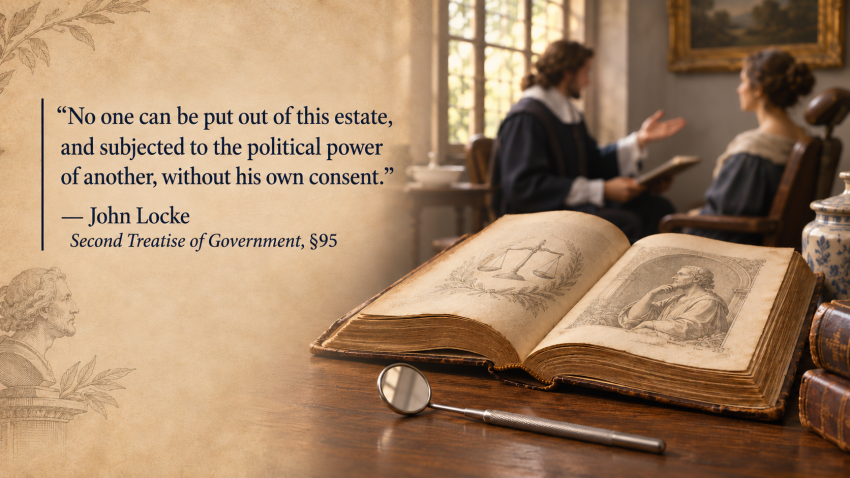
Locke is writing about political authority, not dentistry, in Second Treatise of Government, §95. That difference matters. Still, his starting point is useful: no person should be subjected to another’s authority without that person’s own consent. The point is not merely that agreement must be visible. The point is that it must belong to the person who gives it.
In a dental setting, expertise creates an unavoidable inequality. One person understands the procedure, the materials, and the likely paths forward; the other may be anxious, uncomfortable, short on time, or simply unfamiliar with the terms. Expertise is not coercion. But it makes a signature an ambiguous sign. If a patient signs because the dentist says, “This is what we do,” we know that the patient complied. We do not yet know that the decision was their own.
Consider a person offered a crown. If they cannot say what problem it is meant to solve, why that approach is recommended, what the central alternatives are, or what follows from delaying treatment, their hand may move freely while their reasoning has not. Compliance and consent are not the same thing.
Aristotle: Choice Requires Deliberation
Aristotle gives the argument its sharpest form. In Nicomachean Ethics, Book III, he distinguishes a voluntary action from a choice. An action can be voluntary in the thin sense that no one physically forced it. Choice is richer: it follows deliberation about means that are within one’s power.
This distinction matters. A patient can voluntarily sign a form and still not have chosen in Aristotle’s stronger sense. The person may know the name of a procedure without understanding why it is proposed or what it is being compared with. Knowing a label is not the same as judging between reasons.
A real discussion does not require a patient to become a dentist. It requires enough structure for deliberation: the problem to be addressed, the proposed means, the relevant alternatives, and the important consequences of choosing, waiting, or declining. Without those distinctions, “Do you agree?” is less a question than a request for a signature.
Kant: A Person Is Not a File to Complete
Kant’s Groundwork of the Metaphysics of Morals gives a second test. He argues that a rational person must always be treated as an end and never merely as a means. A form does not automatically violate that principle. But a process whose real purpose is only to secure the office, complete the chart, or move the appointment along can.
If the conversation exists chiefly to obtain a signature, the signer is being used to produce administrative security. If the conversation makes the reasons intelligible and leaves room for questions, the person is treated as someone capable of adopting or rejecting the proposal. The difference is not whether a form exists. The difference is what the form follows.
The proper order is simple: reasons, questions, deliberation, decision, record. A signature belongs at the end of that sequence, not in place of it.
Plato: Expertise Has a Proper End
Plato supplies the professional side of the argument. In Book I of the Republic, Socrates argues that a genuine craft is directed toward the good of the thing it serves. His example is medicine: the art considers the good of the body, not merely the interest of the practitioner.
That does not mean the dentist should decide for the patient. That would turn expertise into authority over another person’s life. Plato explains why a professional should offer reasons rather than a sales pitch; Locke, Aristotle, and Kant explain why the other person must still deliberate. Expertise should make another person’s reasoning possible, not unnecessary.
A good recommendation therefore has to be argumentative. It should say: this is the condition I believe we are addressing; this is why I think this course is better; these are the meaningful alternatives; and this is what I do and do not know. That is not vagueness dressed up as care. It gives a person something with which to reason.
What a Real Conversation Must Show
The point is not to turn every appointment into a seminar. The point is to see whether the person has actually participated in the decision. A useful test is whether the patient can:
- say in their own words what problem is being addressed;
- state the reason for the recommendation, rather than merely name the procedure;
- distinguish the central alternatives and their consequences; and
- explain how their own priorities—such as time, cost, appearance, discomfort, or long-term concerns—bear on the choice.
These are not magic words. They do not make a difficult decision easy. They are signs that a person has had the chance to deliberate rather than merely comply.
For Dental Students
It is tempting to learn the process as a sequence: explain, sign, begin. But that order conceals the real question. The question is not, “Did I complete the form?” It is, “Could this person explain the choice as their own?”
If the answer is no, more paperwork does not solve the problem. It merely records a thinner version of the conversation. The professional task is not to make reasoning disappear under a signature. It is to give the patient reasons that can be weighed, questioned, and accepted or refused.
Forms have a place. They can preserve a record of a decision. But philosophy forces a plain conclusion: consent is not a signature, though a signature may record consent.
Facebook Comments